Stop Treating Accra's Informal Waste Collectors Like the Problem
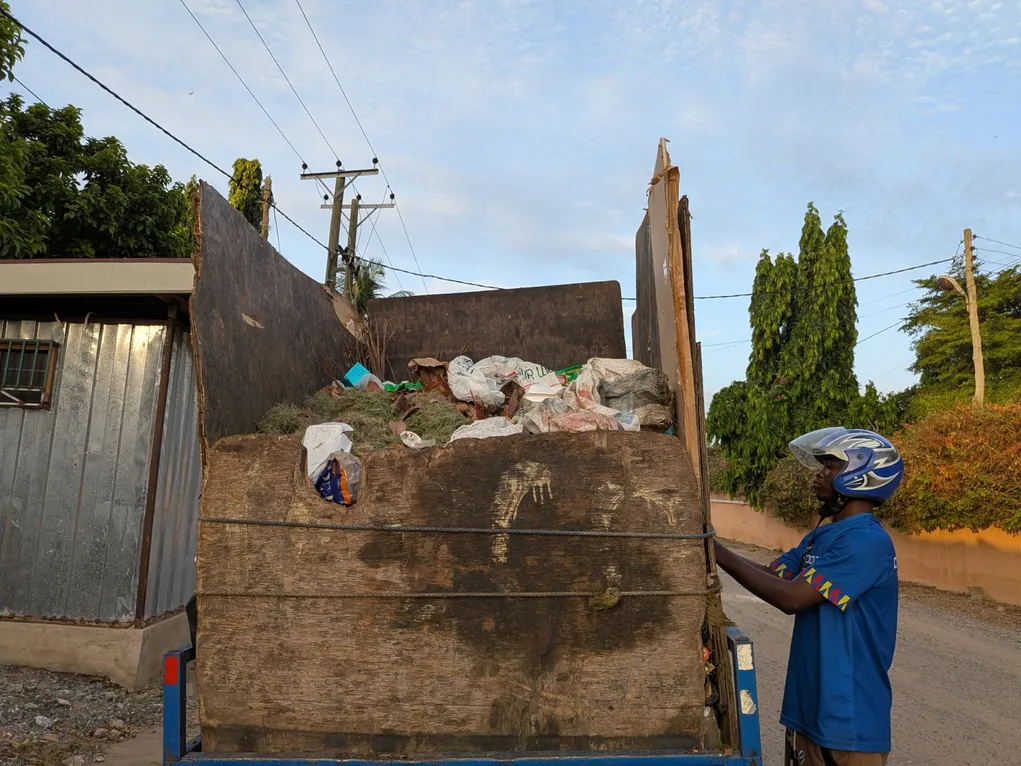
Before sunrise in Madina, before the official waste trucks make their rounds, the informal collectors are already at work. They pull up to compound gates on aboboyaa, the small motorised cargo tricycles that ferry much of Ghana’s everyday goods. They lift household bins on board and ride off to wherever the receiving end of Accra’s waste system happens to be working that week. For millions of Ghanaians, this is the waste collection system. It is also the system we keep deciding to break.
This month, the Tricycle Operators Association announced a nationwide protest over the closure of a dump site. The headline reads like an inconvenience. Set it next to two other recent stories: refuse buildup as Accra’s landfill capacity crisis deepens, and the government reopening the Achimota transfer station to clear a post-flood waste backlog. A pattern emerges. At the exact moment Accra is overflowing with refuse, public discourse keeps finding ways to remove one of the few groups still moving it.
That is the wrong direction.
Who actually picks up Ghana’s waste
Aboboyaa, the small three-wheeled cargo vehicles that ferry everything from charcoal to building materials to bins of household refuse, are used for many trades in Accra. Not every aboboyaa operator is a waste collector. But the ones who are happen to be the closest thing many neighbourhoods have to a reliable waste service. The picture on the ground is messier than the official version. Some neighbourhoods have formal contractors with branded trucks. Plenty don’t, even when they’re meant to. Many estates work directly with aboboyaa collectors. And across much of the city, the choice is between an informal collector, an irregularly visiting refuse skip, or nothing at all.
A Joy News report from Kaneshie Market this month showed what happens when “nothing” is the option. The container at the market entrance overflows. Food traders sell beside the dump. Residents, with no formal collection of their own and full landfills behind them, drop their household waste there too. The market becomes a public health hazard not because informal collectors are missing, but because, in many parts of Accra, they are the only system left.
The lazy framing
For decades the policy frame around informal waste workers has been roughly: formal good, informal bad. Authorised contractors with branded trucks are clean. Tricycle operators are a sanitation problem in their own right. The answer is to “phase them out.”
This is not just lazy. It is provably wrong.
A 2026 study by Ghana’s Institute of Statistical, Social and Economic Research (ISSER), presented at a stakeholder forum on sanitation investment, found that informal sector actors, explicitly including aboboyaa operators, are core participants in the waste management system, not peripheral nuisances. The same study calculated that poor sanitation costs Ghana an estimated 6.2 billion cedis every year in disease burden across malaria, cholera, pneumonia, typhoid and diarrhoea, and that the country is losing roughly 107,000 lives annually to those five conditions. ISSER cited the World Bank’s well-established figure that every dollar invested in sanitation generates approximately $5.50 in return.
If informal collectors were the problem, removing them would shrink that 6.2 billion cedis. The math runs the other way. The neighbourhoods most reliant on them are the same ones whose drains choke first, whose markets fester first, and whose children get sick first. These collectors are not making the crisis worse. They are the only reason it is not far worse.
In Ghana, “informal” too often gets translated as “illegal” or “disorderly”. But in waste collection, informal really means unsupported. The aboboyaa waste collector hasn’t refused regulation. None has been offered. He hasn’t refused training. None has been provided. He doesn’t have a route plan, a digital receipt, or a guaranteed disposal site. He has a tricycle, a phone, and a willingness to do work the formal sector has not figured out how to scale to.
Meanwhile, the upside being left on the table is enormous. On a recent television show, journalist Saddick Adams argued that Ghana spends close to $390 million a year cleaning up after waste, about 1.6% of GDP, while sitting on what could be a $4 billion industry in recycling, composting, and waste-to-energy. Ghana, he noted, recycles only around 5% of what it generates, against more than 90% in countries like Singapore, Japan and Malaysia. His figures are debatable at the margins; the order of magnitude is not.
At the Kpone landfill near Tema, the people already capturing some of that upside aren’t multinationals. They are upcyclists, informal sorters who pull plastic, metal and glass out of the dump for re-sale, with some materials shipped abroad to be recycled. The circular economy is not waiting for permission. It is already running on tricycles and informal labour.
What displacement actually does
When a dump site closes without an alternative, the waste does not disappear. It moves. It ends up at the back of a market, in a drainage channel, on the side of a road. The aboboyaa waste collector does not stop working. He just has nowhere legal to go. The household does not stop generating waste. It just stops paying for collection. The MMDA loses revenue, the drain blocks, the next flood comes, and the headline writes itself: “post-flood waste crisis.”
This is precisely the cycle Accra is currently in. The Achimota transfer station is being reopened not because a long-term plan succeeded but because the short-term collapse demanded it. The Ghana Hydrological Authority has warned that drains were designed to carry water, not solid waste, and that the annual dredging contracts are a stopgap, not a strategy. They are a tax on failure.
Banning tricycle operators in this environment is not regulation. It is removing the ambulance because you don’t like the colour of the paint.
What integration should look like
The alternative to displacement is not tolerance. It is integration. A functional Accra waste system that includes aboboyaa waste collectors looks something like this:
- Digital dispatch and routing, so households know who is collecting their waste, when, and where it is going.
- Traceable disposal, so every load has a verified destination, not a roadside or a drain.
- Fair, transparent payment, so collectors are paid for the work they do, and customers can see what they are paying for.
- Credentialing and training, so operators have ID, safety equipment, and a path to upgrade their vehicles and skills.
- MMDA partnership, so districts treat the existing informal collector workforce as a delivery channel, not a competitor to be eliminated.
At Jumeni, this is the model we are betting on. Our network is built around the aboboyaa waste collectors who have always served these neighbourhoods, equipped with the technology, payment infrastructure, and verified disposal partners that turn informal hustle into formal service. Across 73 neighbourhoods in Accra, the same workers being threatened by closures elsewhere are running on-time pickups for households and businesses through the Jumeni app. It is not the only way to do this. It is one way that is already working.
Stop bulldozing the system that works
The Tricycle Operators Association is protesting because their livelihood was removed without an alternative. The deeper story is that the rest of us are losing the only piece of Accra’s waste system that has been quietly functioning all along.
This is not a romantic argument about preserving informality. Informal collectors deserve safer equipment, fair pay, real protections, and a clean place to drop a load. That is what integration is for. The point is that you do not get to those outcomes by criminalising the workers. You get there by building infrastructure, regulation and technology around them.
Informal waste collectors are not Ghana’s waste problem. They are the part of the waste system we already have. The choice in front of MMDAs, regulators and the next government is not whether to formalise them. It is whether we build with them or against them.
The next flood is already on its way. We can let it find the same broken system we had last year, or we can spend the months in between making the one we have actually work.
Sources
- Tricycle Operators Association to stage nationwide protest over closure of dump site, GhanaWeb
- Accra hit by refuse buildup as landfill capacity crisis deepens, GhanaWeb
- Gov’t, Zoomlion reopen Achimota transfer station to ease post-flood waste crisis, Peace FM Online
- Uncollected waste, indiscriminate dumping at Kaneshie Market raise health concerns, Joy News / Channel One TV
- An Economic Analysis of the Benefits of Adequate Investment in Waste Management and Sanitation in Ghana, Institute of Statistical, Social and Economic Research (ISSER), University of Ghana, 2026 stakeholder forum
- What a Waste 2.0: A Global Snapshot of Solid Waste Management to 2050, World Bank
- Poor solid waste management poses serious threat, GHA warns, YouTube
- Saddick Adams Reveals How Waste Management Can Generate Billions Of Dollars For Ghana, YouTube
- The Reality of Waste Management, Eco Backpacking Ghana, YouTube. Filmed at Kpone Landfill.